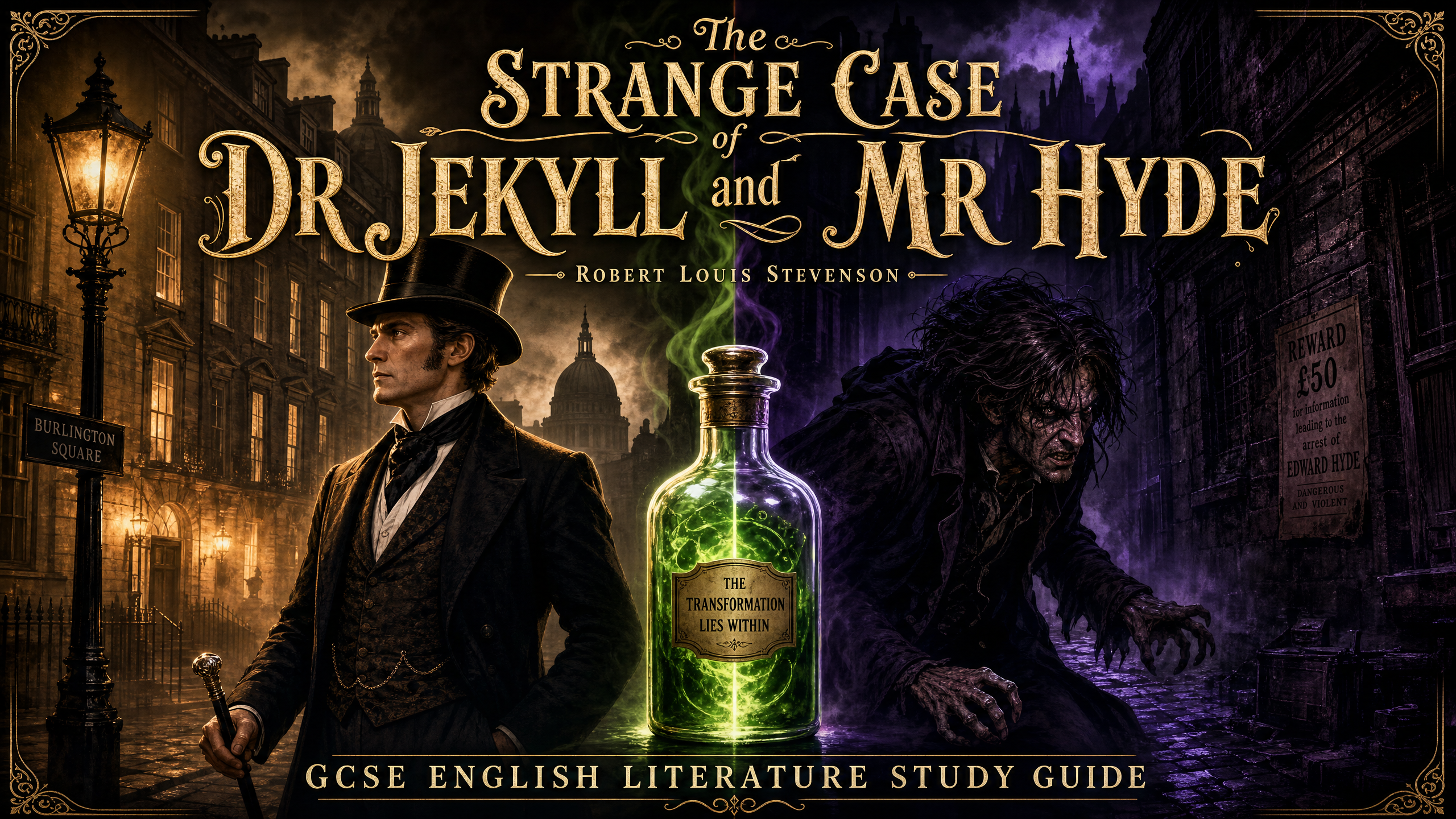
The Strange Case of Dr Jekyll and Mr Hyde
A chilling exploration of human duality, 'The Strange Case of Dr Jekyll and Mr Hyde' exposes the dark consequences of Victorian repression. This masterclass in Gothic suspense will teach you how writers use setting and narrative structure to explore the monster within us all.
Study Notes
Overview
Published in 1886, Robert Louis Stevenson's The Strange Case of Dr Jekyll and Mr Hyde is a seminal Gothic novella that probes the depths of human nature. Set in a fog-bound, labyrinthine London, the text follows the respectable lawyer Mr Utterson as he investigates the bizarre connection between his old friend, the brilliant Dr Henry Jekyll, and the repulsive, violent Mr Edward Hyde. For GCSE candidates, this text is a goldmine for analyzing how writers use structure, setting, and symbolism to critique society. Examiners consistently reward students who can move beyond the surface horror story to explore Stevenson's deeper concerns: the hypocrisy of Victorian morality, the anxieties surrounding evolutionary theory, and the destructive consequences of psychological repression.
Plot/Content Overview
The narrative unfolds through a series of discoveries, primarily guided by Mr Utterson:
- Story of the Door: Mr Enfield recounts seeing a deformed man, Hyde, trample a young girl and pay compensation using a cheque signed by Dr Jekyll.
- Search for Mr Hyde: Utterson discovers Jekyll has left everything to Hyde in his will. He meets Hyde and is repulsed.
- The Carew Murder Case: A year later, Hyde brutally murders Sir Danvers Carew, a respected MP. Utterson leads the police to Hyde's rooms, but Hyde has vanished.
- Incident of the Letter: Jekyll appears deathly ill and claims he is done with Hyde, showing Utterson a letter supposedly from Hyde. Utterson's clerk notes the handwriting is identical to Jekyll's.
- Remarkable Incident of Dr Lanyon: Jekyll briefly becomes sociable again, then suddenly secludes himself. Dr Lanyon dies of shock after discovering Jekyll's secret, leaving a letter for Utterson to open only after Jekyll's death.
- The Last Night: Jekyll's butler, Poole, terrified by strange voices in the laboratory, fetches Utterson. They break down the door to find Hyde dead from suicide, and a confession from Jekyll.
- Henry Jekyll's Full Statement of the Case: The final chapter reveals the truth: Jekyll created a potion to separate his good and evil sides, but the evil Hyde eventually overpowered him.
Themes
Theme 1: Duality of Human Nature
Stevenson's central argument is that humanity is inherently dualistic, containing both civilized morality and primitive savagery. Jekyll's tragic flaw is believing these sides can be neatly separated. Stevenson uses the physical transformation to make a psychological point: when we suppress our darker impulses, they grow stronger and more violent.
Key Quotes:
- "Man is not truly one, but truly two." (Chapter 10) - Jekyll's definitive statement on human nature, showing his realization that good and evil are inextricably linked.
- "My devil had been long caged, he came out roaring." (Chapter 10) - Stevenson uses the metaphor of a caged animal to show how repression fuels violent outbursts. The verb 'roaring' emphasizes Hyde's bestial nature.
Theme 2: Victorian Hypocrisy and Repression
The novella serves as a sharp critique of a society obsessed with outward respectability. Characters like Utterson and Enfield "mortify" their desires to maintain their status. Jekyll creates Hyde specifically so he can indulge his forbidden desires without damaging his public reputation. The text suggests that strict social codes breed hypocrisy and hidden vice.
Key Quotes:
- "I concealed my pleasures." (Chapter 10) - Jekyll admits that the pressure to appear respectable forced him into a life of deceit long before Hyde existed.
- "A volume of some dry divinity on his reading desk, until the clock of the neighbouring church rang out the hour of twelve, when he would go soberly and gratefully to bed." (Chapter 2) - Describes Utterson's rigid, joyless routine, highlighting the extreme self-denial expected of Victorian gentlemen.
Theme 3: Science vs. Religion
Stevenson taps into Victorian anxieties about the rapid advancement of science, particularly Darwin's theory of evolution. Jekyll's experiments represent 'transcendental' or mystical science that challenges religious boundaries, contrasting sharply with Lanyon's traditional, rational medical views. Hyde himself is described in terms that suggest evolutionary regression (atavism).
Key Quotes:
- "Unscientific balderdash." (Chapter 2) - Lanyon's dismissal of Jekyll's work, showing the conflict between orthodox science and dangerous experimentation.
- "Ape-like fury." (Chapter 4) - Stevenson uses evolutionary imagery during the Carew murder to align Hyde with primitive, pre-human brutality.
Character Analysis
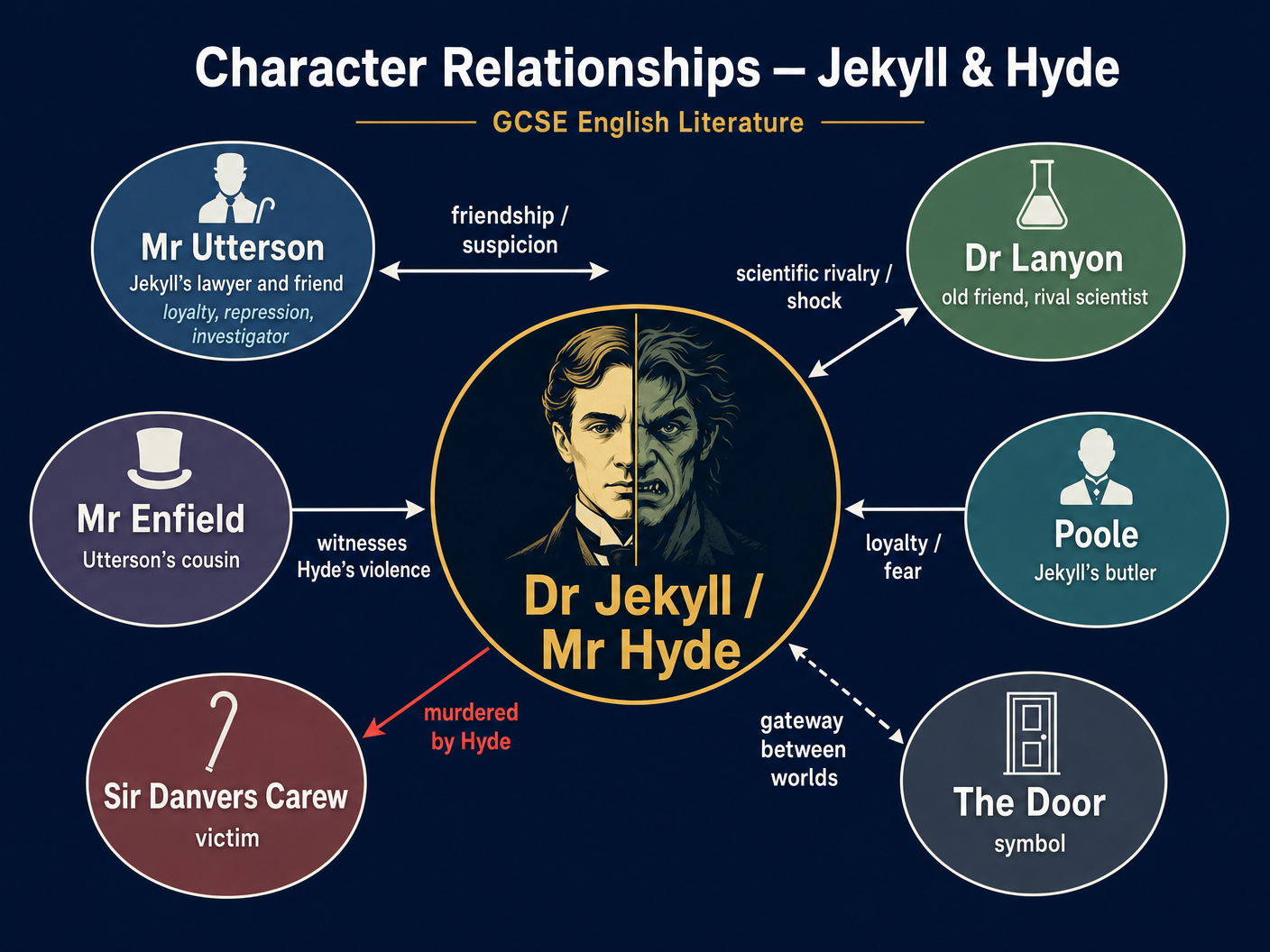
Dr Henry Jekyll
Role: The tragic protagonist; a brilliant, wealthy, and highly respected doctor whose ambition leads to his downfall.
Key Traits: Ambitious, hypocritical, tormented, arrogant.
Character Arc: Moves from arrogant confidence in his ability to control Hyde, to desperate addiction to the potion, and finally to complete loss of control and despair.
Essential Quotes:
- "A large, well-made, smooth-faced man of fifty, with something of a slyish cast perhaps, but every mark of capacity and kindness."
- "I was slowly losing hold of my original and better self, and becoming slowly incorporated with my second and worse."
Mr Edward Hyde
Role: The antagonist; the physical embodiment of Jekyll's repressed evil and desires.
Key Traits: Violent, primitive, deformed, remorseless.
Character Arc: Begins as a smaller, younger aspect of Jekyll, but grows in size and strength as he is indulged, eventually destroying his creator.
Essential Quotes:
- "He gives a strong feeling of deformity, although I couldn't specify the point."
- "Snarled aloud into a savage laugh."
Mr Gabriel John Utterson
Role: The narrative guide and investigator; a lawyer representing Victorian respectability and rationality.
Key Traits: Loyal, repressed, curious, rational, tolerant.
Character Arc: Utterson's rational worldview is progressively dismantled as he investigates the mystery, culminating in his inability to comprehend the supernatural truth.
Essential Quotes:
- "Lean, long, dusty, dreary and yet somehow lovable."
- "If he be Mr Hyde... I shall be Mr Seek."
Writer's Methods
Stevenson employs a sophisticated range of techniques to craft meaning:
- Narrative Structure: The use of multiple, limited perspectives (Utterson, Lanyon, Jekyll) creates a fragmented narrative that mirrors Jekyll's fractured identity. It delays the revelation, building suspense and forcing the reader to piece together the truth alongside Utterson.
- Setting and Pathetic Fallacy: London is depicted as a Gothic nightmare of fog, darkness, and labyrinthine streets. The thick, brown fog physically obscures the truth and morally obscures the characters' actions. For example, the "chocolate-coloured pall" during Utterson's journey to Soho reflects the moral decay of the city.
- Symbolism: The architecture of Jekyll's house is highly symbolic. The respectable, wealthy front represents his public persona, while the neglected, blistered back door used by Hyde represents his hidden, shameful desires.
- Animalistic Imagery: Stevenson consistently uses zoomorphism to describe Hyde (e.g., "hissing," "snarled," "ape-like"), drawing on Darwinian fears of regression to emphasize Hyde's lack of civilized morality.
Context
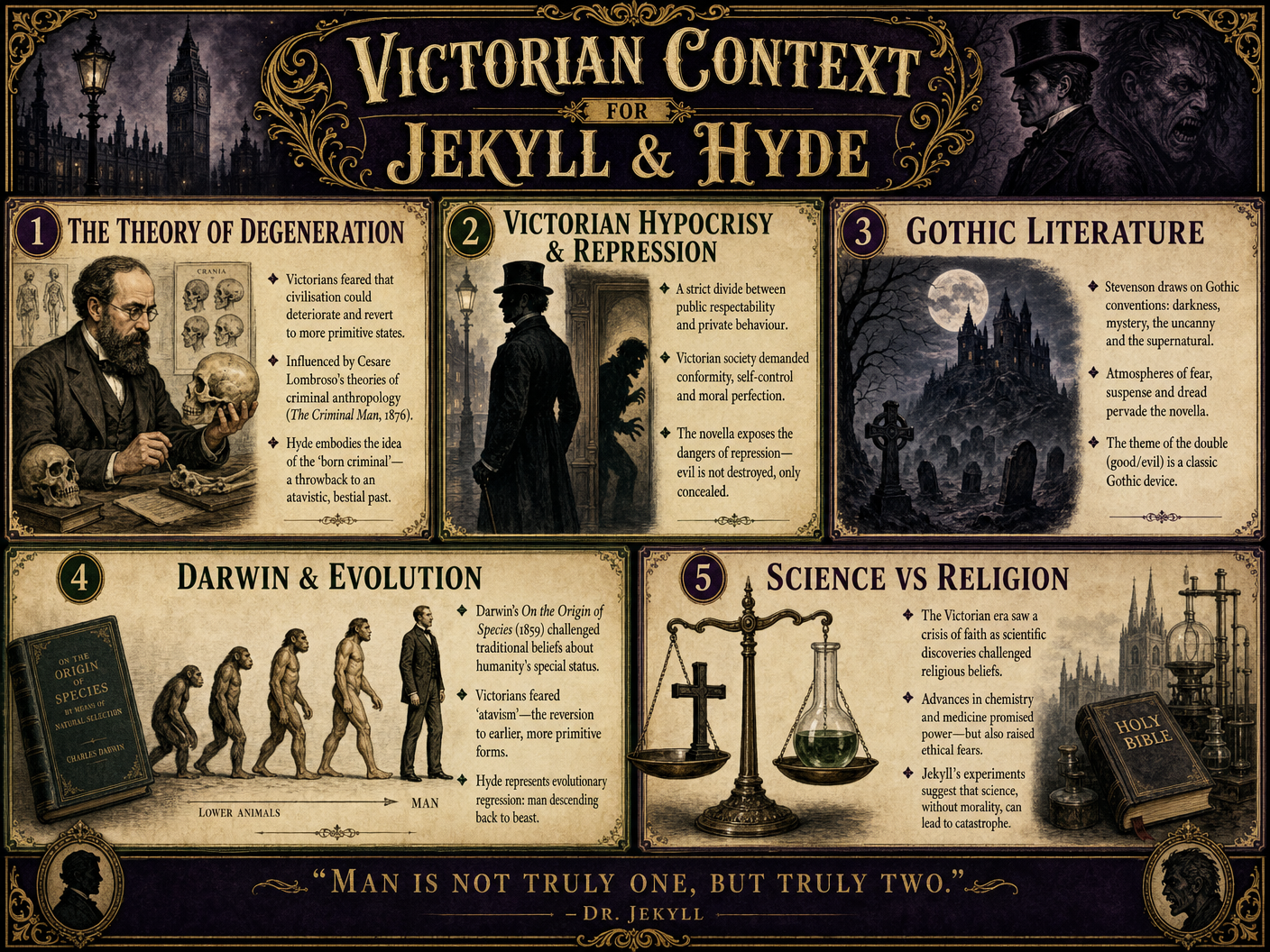
To achieve top marks, candidates must integrate an understanding of the Victorian era:
- The Fin de Siècle: The late 19th century was a period of anxiety about societal decline and moral decay.
- Evolution and Atavism: Following Darwin's Origin of Species (1859), Victorians feared that if humanity evolved from animals, it could 'devolve' back into a primitive state (atavism). Hyde embodies this fear.
- The Public/Private Divide: Victorian gentlemen were expected to uphold strict moral standards publicly, leading many to lead secret double lives to fulfill illicit desires. The text critiques the hypocrisy this demanded.
- Gothic Conventions: Stevenson utilizes the Gothic tradition (the double/doppelgänger, eerie settings, the uncanny) to explore psychological rather than purely supernatural horrors.
Visual Resources
2 diagrams and illustrations
Interactive Diagrams
1 interactive diagram to visualise key concepts
Conceptual Flow Outline
The Cycle of Repression and Destruction in Jekyll's Character Arc
Worked Examples
2 detailed examples with solutions and examiner commentary
Practice Questions
Test your understanding — click to reveal model answers
Starting with this extract (from Chapter 1, where Enfield describes the door), explore how Stevenson creates a sense of mystery and tension. Write about the extract and the novel as a whole.
Hint: Focus on the description of the door as a symbol of neglect and secrecy, then discuss how the narrative structure (delaying the truth) builds tension later.
Explore how Stevenson presents the relationship between Dr Jekyll and Dr Lanyon.
Hint: This isn't just about two friends falling out; it's a symbolic clash between rational, traditional science and dangerous, mystical experimentation.
How does Stevenson use setting to reflect the themes of the novella?
Hint: Think about the contrast between Jekyll's front door and Hyde's back door, and the use of fog in London.
Explore how Stevenson presents the idea that reputation was important to Victorian gentlemen.
Hint: Look at Utterson's desire to protect Jekyll, Enfield's rule about not asking questions, and Jekyll's reason for creating Hyde.